
Engineering study · Reviewed November 1, 2026
Carbon felt insulation for semiconductor furnace
Compare thickness and heat loss, then check material evidence for your hot zone.
Request engineering review →Thickness & heat loss
Illustrative planar estimate. Purity and outgassing are unknown.
1000–2600°C; input range is not a material rating.
10–500 mm after installation/compression.
15–400°C; assumed boundary, not predicted shell temperature.
0.01–5; match temperature interval, gas, pressure, density and direction.
0.1–150 m²; cylinders require a radial model.
0–8784 h; excludes ramps, cooling and idle periods.
0.1–50; study target, not an industry acceptance limit.
All * inputs are required. Results update immediately.
No automatic gas correction. Changing atmosphere requires matching conductivity data.
Does not change k or certify material suitability.
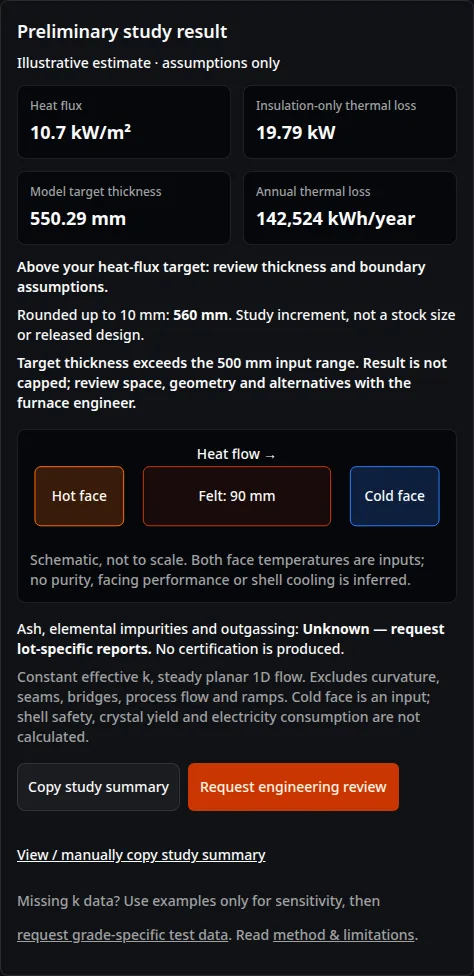
Preliminary study result
Illustrative estimate · assumptions only
Heat flux
10.7 kW/m²
Insulation-only thermal loss
19.79 kW
Model target thickness
550.29 mm
Annual thermal loss
142,524 kWh/year
Above your heat-flux target: review thickness and boundary assumptions.
Rounded up to 10 mm: 560 mm. Study increment, not a stock size or released design.
Target thickness exceeds the 500 mm input range. Result is not capped; review space, geometry and alternatives with the furnace engineer.
Ash, elemental impurities and outgassing: Unknown — request lot-specific reports. No certification is produced.
Constant effective k, steady planar 1D flow. Excludes curvature, seams, bridges, process flow and ramps. Cold face is an input; shell safety, crystal yield and electricity consumption are not calculated.
View / manually copy study summary
Missing k data? Use examples only for sensitivity, then request grade-specific test data. Read method & limitations.
1. Four decisions before specifying a felt grade
Use the tool to test sensitivity, then qualify the material and installed assembly separately. A lower modeled heat flux alone does not establish cleanliness, reactor compatibility or crystal quality.
Match conductivity to conditions
Temperature interval, direction and atmosphere belong with every k value.
Evidence & scope →Separate purity from total residue
Request an analytical method appropriate to the required elemental limits.
Evidence & scope →Compare the installed assembly
Conformability, retention, joints and facing are part of the selection decision.
Evidence & scope →Validate the complete thermal field
The published 150 mm PVT study is system-specific; it is no universal yield promise.
Evidence & scope →2. Purity qualification: known, requested and unknown
No universal B/P/Al or total-ash ceiling is established for all semiconductor furnaces here. The process owner must set acceptance limits. ASTM C561 describes a residue estimate and explicitly limits its use for purified graphite. ASTM method limitation
On narrow screens, scroll the table horizontally. Keyboard: focus the table region and use arrow keys.
| Question | What to request | Current page status |
|---|---|---|
| Total impurity / ash claim | Exact measurand, method, lot and uncertainty | Unknown for your proposed lot |
| B, P, Al and process-critical metals | Element-specific results and limits of quantification | Acceptance limits to be agreed |
| Cleanliness after machining | Sampling stage, handling and packaging record | Not established by a raw blank certificate |
| Outgassing | Test temperature, pressure, time, gas species and exposed area | Not calculated from a purity selection |
For context, Mersen describes purification options below 20 ppm for its CALCARB family. That manufacturer statement is neither a universal semiconductor threshold nor a certificate for material offered on this page. Manufacturer scope
3. Rayon, PAN and heat treatment: compare grades fairly
SGL describes cellulose-derived soft felts and distinguishes carbonized from higher-temperature-treated graphite-like felt. That source does not justify a fixed conductivity advantage for every rayon grade over every PAN grade. SGL material description
On narrow screens, scroll the table horizontally. Keyboard: focus the table region and use arrow keys.
| Dimension | Hold constant | Decision if missing |
|---|---|---|
| Thermal performance | Temperature, gas/pressure, direction and installed density | Do not rank by precursor name |
| Handling / shedding | Finished facing, cut edges and handling procedure | Request assembly-level evaluation |
| Purity | Same elements, sampling and analytical method | Request comparable lot evidence |
| Dimensional behavior | Installed compression and thermal history | Trial the actual assembly |
4. Method, units and conductivity evidence
The tool uses steady, one-dimensional planar transfer with constant interval-effective conductivity: q [kW/m²] = k [W/(m·K)] × (T_hot − T_cold) [K] / thickness [mm]. The mm-to-m and W-to-kW conversions cancel. Thermal power Q = q × area; annual thermal energy = Q × hours at condition; target thickness = k × (T_hot − T_cold) / target q.
If k varies with temperature, the appropriate interval-effective value corresponds to the integral of k(T) divided by the hot-to-cold temperature difference under matching conditions. A single room-temperature datum is not automatically that value. This tool performs no integration, pressure correction or simulation.
On narrow screens, scroll the table horizontally. Keyboard: focus the table region and use arrow keys.
| Evidence | Useful information | Boundary |
|---|---|---|
| Guarded hot plate — ASTM C177 | Steady heat flux through flat specimens | Instrument range, geometry and anisotropy need review; no automatic 2400°C validation |
| Flash — ASTM E1461 | Thermal diffusivity; k also requires density and heat capacity | Dense/opaque specimen assumptions need care for porous felt |
| Ihle & Wellmann study | Combines measurements, heating experiments and simulation at high temperature | Specific samples and setups; no universal k curve |
C177 scope · E1461 scope · High-temperature study
Exclude cylinders, seams, fasteners, openings, transient storage and flowing gas from this planar estimate. A furnace engineer should use radial or full geometry calculations where these effects matter. The imposed cold face is not a prediction of shell or touch temperature.
Request conductivity data for your furnace conditions →5. Rigid CBCF versus soft graphite felt
Mersen describes machinable rigid CBCF and conformable soft felt. Use those construction differences to frame an assembly trial; compare thermal data separately. Construction evidence
On narrow screens, scroll the table horizontally. Keyboard: focus the table region and use arrow keys.
| Criterion | Rigid CBCF | Soft felt |
|---|---|---|
| Geometry | Machined board/cylinder/disc; drawing controls fit | Layered wrap; retention controls installed form |
| Installation | Check joints, fragile edges and access | Check gaps, compression and layer overlap |
| Maintenance | Define inspectable surfaces and replaceable sections | Record installed thickness and repeatable wrapping |
| Cost comparison | Include machining, facing, inspection and spare parts | Include fitting labor, retention and replacement downtime |
6. SiC PVT: separate insulation loss from growth performance
The thermal-property study considers carbon materials used around PVT crucibles and validates properties against heating setups. It does not validate the k values in our presets or predict production yield. Silicon-vapor exposure, changed material condition and a new crucible arrangement require a separate compatibility and thermal-field review. No universal degradation rate or conductivity multiplier is supplied here. Study and limitations
Practical review: record the recipe, location and orientation of replaced pieces; inspect for mass, surface and dimensional changes; compare like-for-like runs before assigning a change in yield to insulation.
7. CZ silicon: control the evidence chain around contamination
For a CZ hot zone, ask the furnace owner which exposed parts, gas paths and analytical measurements belong in the qualification plan. A felt ash figure cannot identify the source of a melt or ingot contaminant. This page has no verified data set linking a particular felt change to carrier lifetime.
Keep the existing qualified configuration as the comparison baseline. Document lot identity, handling, insulation condition and process settings; agree contamination sampling before changing multiple components at once.
8. Reactive gases, epitaxy and quench flow: outside the model
Carbon insulation application descriptions for vacuum/inert conditions do not approve it for air, reactive chemistry or high-velocity flow. The tool suppresses results for reactive/flowing modes. The epitaxy example assumes a separate insulation enclosure and provides no approval for material exposed to reactor chemistry. Atmosphere scope
Minimum alternative path: send gas composition, pressure/flow history, exposed surfaces, cleaning chemistry and temperature cycle to the furnace owner and material supplier. Obtain assembly-specific erosion, compatibility and contamination criteria before proceeding.
9. Facing options: specify function and verify the assembly
Mersen offers protective surface treatments aimed at reactivity, permeability and dust erosion. These are supplier- and treatment-specific claims; a facing is not a guarantee of zero particles or complete vapor exclusion. Protective treatment options
On narrow screens, scroll the table horizontally. Keyboard: focus the table region and use arrow keys.
| Option to discuss | Intended function | Evidence still needed |
|---|---|---|
| Graphite foil facing | Continuous surface / particle management | Seams, edges, attachment and contamination behavior |
| CFC protection | Mechanical protection in the proposed assembly | Supports, thermal bridges, erosion and handling evidence |
| Coating or infiltration | Chemistry-specific surface or bulk modification | Gas compatibility, coating integrity and revised thermal data |
| Bare felt | Simple assembly where exposure permits | Particle release, retention and process acceptance |
10. Bake-out and cleanliness: define release criteria first
No validated universal ramp, dwell temperature or outgassing threshold is available here. A treatment suitable for one grade may exceed another assembly’s limits. Agree a supplier/furnace-owner procedure and document what constitutes release to production.
On narrow screens, scroll the table horizontally. Keyboard: focus the table region and use arrow keys.
| Stage | Record | Release question |
|---|---|---|
| Receipt | Lot, packaging, visible condition and storage exposure | Does it match the ordered condition? |
| Assembly | Handling, tooling, facing and retention | Can introduced contamination be controlled? |
| Approved bake-out | Time, temperature, gas, pressure and measurement basis | Does it meet the agreed residual-gas / cleanliness endpoint? |
| Trial and inspection | Baseline comparison and inspection record | Has the furnace owner accepted the configuration? |
11. Larger boules require system validation
The cited RSC work studies thermal-field optimization for 150 mm SiC growth. Its results do not prescribe a universal radial temperature tolerance for a 200 mm boule or require one insulation construction in every reactor. 150 mm study scope
When scaling a hot zone, review coil position, ports, crucible and seed geometry, measurement locations, insulation joints and material properties together. Set acceptance criteria with the process owner; confirm model predictions against the actual furnace.
12. Three reproducible thermal studies
These are calculated scenarios using assumed inputs, not customer case studies or measured savings. All use hot/cold faces 2200/60°C, area 1.85 m², 7200 h/year and target flux 1.75 kW/m². Only thickness or k changes.
On narrow screens, scroll the table horizontally. Keyboard: focus the table region and use arrow keys.
| Scenario | k (W/m·K) / t (mm) | Flux / power | Annual thermal loss | Target thickness |
|---|---|---|---|---|
| A — SiC PVT example | 0.45 / 90 | 10.70 kW/m² / 19.795 kW | 142,524 kWh | 550.29 mm → 560 mm |
| B — more installed thickness | 0.45 / 120 | 8.025 kW/m² / 14.84625 kW | 106,893 kWh | 550.29 mm → 560 mm |
| C — doubled effective k | 0.90 / 90 | 21.40 kW/m² / 39.59 kW | 285,048 kWh | 1100.57 mm → 1110 mm |
A: 0.45 × 2140 / 90 = 10.70 kW/m². B lowers modeled insulation loss by 25% at the same imposed boundaries; that is not a prediction of electrical savings. C doubles loss when k doubles. All three exceed the chosen target and need more than the tool’s 500 mm input range; assess space and model suitability rather than treating the rounded thickness as an order size.
13. Engineering and sourcing FAQs
Purity and evidence
Does low total ash prove semiconductor suitability?
No. Agree element-specific limits with the process owner and request a lot-linked assay. A residue number alone cannot establish the dopant or metal profile.
Can ASTM C561 certify ultra-pure felt?
Its published significance explicitly excludes determining ash in purified graphite. Ask the laboratory to justify the analytical method, blank control and quantification limit for the actual material.
What belongs in an elemental analysis report?
Lot and sample identity, sampling location, individual elements, units, method, detection/quantification limits and uncertainty. Ask how sampling represents the machined finished part.
Is “not detected” the same as zero impurity?
No. It is bounded by the stated method and detection limit. A detection limit above your acceptance threshold cannot demonstrate compliance.
Does the calculator generate a purity certificate?
No. Purity and outgassing are unknown. Requested material and evidence options provide RFQ context and do not change the thermal calculation.
Thermal model and inputs
Where do the preset values come from?
They are illustrative study assumptions, not measured material data, supplier ratings or process recipes. Replace them with approved boundary conditions and grade-specific effective conductivity.
Can I use room-temperature conductivity?
Only if it is defensible for your temperature interval. Request the test curve and conditions; the tool uses a single interval-effective k and performs no temperature integration.
Does changing gas automatically correct the output?
No. Enter conductivity measured or validated for the selected gas and pressure. The tool does not infer gas conduction or process flow.
Can the tool size a cylindrical PVT enclosure?
It offers a planar sensitivity comparison. Actual cylinders need a radial model, while end losses, openings and thermal bridges need a complete furnace model.
Does annual thermal loss equal my electricity bill?
No. It covers insulation-only thermal transfer at constant entered conditions. Heater efficiency, load heating, ramps and auxiliaries require separate energy accounting.
Material and process fit
Is rayon always better than PAN?
No universal ranking is established here. Compare specific grades under identical gas, pressure, temperature, installed density and heat-flow direction.
When should I consider rigid CBCF?
Where the assembly needs a machined, self-supporting form. Confirm joints, handling, dimensional stability, conductivity and contamination requirements before selecting a grade.
When should I consider soft felt?
For conformable wraps or layered assemblies where retention and installed compression can be controlled. Inspect gaps and define the assembly thickness rather than relying on roll thickness.
Does a graphite foil facing guarantee zero dust?
No. Ask for the assembly’s particle and erosion evidence, including seams, edges, adhesive or bonding process, and maintenance handling.
Can I use the presets for reactive-gas epitaxy?
No. The epitaxy preset represents a hypothetical isolated insulation enclosure. Reactive chemistry and process-flow compatibility require a reactor-specific review; those modes suppress tool results.
Qualification and purchasing
What bake-out temperature should I specify?
Use the supplier and furnace owner’s validated procedure. Define ramp, dwell, pressure, gas and release criteria for that assembly. This page supplies no universal bake-out recipe.
Can I assume a service life or yield gain?
No. Neither is calculated or guaranteed here. Track condition and performance in a controlled trial with comparable recipes, inspection criteria and maintenance records.
How should I compare quotations?
Normalize finished geometry, required assay, purification, facing, packaging, inspection and expected changeout cost. Confirm exclusions and request a trial-lot plan.
Is there a standard lead time?
No verified current lead time is available here. Obtain a dated quotation separating blank availability, purification, machining, testing and shipping.
What if I do not have conductivity data yet?
Use the examples only to explore sensitivity. Send the drawing, temperature interval, gas/pressure history and installed density to request appropriate data or an engineering review.
14. Sources, review date and evidence limits
Sources checked November 1, 2026. Publisher pages and public standard scopes support only the stated topics. They do not certify this supplier’s material. No audited customer outcomes, current prices, universal bake-out recipe or verified lead times are available on this page. Selection checklists are engineering synthesis; numerical scenarios are explicitly assumed.
Published and reviewed by SiC Crystal Crucibles. Published November 1, 2026; next content review by May 1, 2027, or sooner when a cited method or source changes.
First published 2024; journal issue 2025. Combines laser-flash measurements, heating experiments and simulations for specific carbon materials. Does not validate our example k values or certify any grade.
A particular 150 mm growth-system study. Supports studying the complete thermal field; does not establish universal 200 mm tolerances or a rigid-felt yield guarantee.
Manufacturer information on cellulose-derived soft felt, carbonization/graphitization and vacuum/inert applications. Grade-specific information, not a comparison of all PAN and rayon products.
Manufacturer description of CALCARB CBCF, purification options and protective treatments. Published grade-family properties are not this supplier’s lot certificate.
Public scope and significance: comparative residue estimate with explicit limitations for purified graphite. Not a certification of semiconductor trace-element cleanliness.
Public scope for steady flat-specimen heat flux. Referenced edition is historical as checked; agree the applicable edition and actual instrument conditions with the laboratory.
Public scope emphasizes dense, opaque, homogeneous/isotropic specimens; porous felt requires justified experimental adaptation. Diffusivity alone is not conductivity.
On narrow screens, scroll the table horizontally. Keyboard: focus the table region and use arrow keys.
| Risk | Consequence | Minimum control |
|---|---|---|
| Misuse: assumed k treated as certified | Incorrect thermal sizing or purchase specification | Obtain condition-matched data and drawing review |
| Cost: comparing only price per sheet | Facing, assays, labor or changeout costs omitted | Normalize full assembly and qualification scope |
| Mismatch: reactive gas or curved geometry | Planar thermal result does not answer compatibility or whole-furnace behavior | Use a compatible assembly and appropriate full-system model |
16. Request an engineering review
Copy your study summary, then attach the drawing and missing evidence requirements to your inquiry. A quotation should state the confirmed grade, test scope, acceptance criteria and delivery terms.
- Furnace process, temperature cycle, gas species, pressure and flow history.
- Installed dimensions, heat-flow direction, compression, joints and available space.
- Grade-specific k(T) and test conditions; process-owner elemental limits and sampling requirements.
- Facing, handling, packaging, quantity, delivery country and trial-lot acceptance plan.
Inquiry Email
Attach DWG, STEP, or PDF drawings and include purity, tolerance, quantity forecast, and delivery country.
Instant Chat
WhatsApp Engineering Support
Use WhatsApp for quick engineering clarification before a formal quote.