
Rigid vs. Soft Graphite Felt in SiC PVT Hot Zones: Precursor Chemistry, Thermal Drift, and 200mm Scaling
Compare rigid vs. soft graphite felt insulation for SiC PVT hot zones. Review precursor chemistry, thermal drift, and 200mm RFQ checks before requesting a quote.
Rigid vs. soft graphite felt insulation for SiC PVT is a geometry and qualification decision. Use rigid felt where self-supporting shapes, machined interfaces, and repeatable assembly matter; use soft felt where conformable wraps and gap filling matter. A mixed package can serve both needs. Select Rayon- or PAN-derived grades by measured thermal behavior, purity, and conditioning history rather than precursor name alone. For 200mm growth, qualify the assembled hot zone before approving a material substitution.
For drawing review, compare our PAN carbon felt insulation, graphite felt insulation options, and rigid carbon felt board, or request an engineering RFQ review.
1. Scope, Operational Context, and System Limits
Published and reviewed: October 31, 2026. This English-language guide supports engineering and procurement teams worldwide specifying insulation for 150mm and 200mm SiC physical vapor transport (PVT) hot zones, including conductive n-type and high-purity semi-insulating (HPSI) programs.
Evidence and limits: This is a literature-informed selection and RFQ framework, not a report of our own furnace trials. The sources below cover particular materials and reactor designs. They do not establish universal felt conductivity, service life, impurity acceptance limits, or crystal yield. The comparison matrix and qualification sequence are editorial engineering recommendations for organizing a supplier review.
PVT thermal-property research considers carbon components in the 2,000–2,400°C process regime. That does not mean every insulation layer reaches the source temperature, or every graphite felt is rated for that exposure. Ihle and Wellmann study the characterization problem above 2,000°C using measurements and thermal modeling; their results are material- and condition-specific. Source 1: high-temperature carbon material characterization.
Before comparing quotes, record the local insulation temperature, atmosphere, absolute pressure, heating mode, geometry, measurement direction, and conditioning history. This guide does not cover operation in air or other oxidizing atmospheres. Obtain the selected grade's approved temperature and atmosphere limits from its manufacturer.
2. Heat Transfer at PVT Temperatures: What a Conductivity Value Must Include
Heat travels through the fiber network, the gas in the pores, and thermal radiation between surfaces. Their relative contributions depend on temperature, pressure, fiber arrangement, density, and installed compression. Assigning fixed percentages to these mechanisms without measurements can mislead a furnace model.
For an idealized surface exchange, net radiative heat flux varies with ε_eff σ (T_hot⁴ − T_cold⁴), using absolute temperatures in kelvin. This relationship explains the strong temperature sensitivity of radiation; it is not an equation for the effective conductivity of a porous felt pack.
Request conductivity data with the test temperature, gas and pressure, heat-flow direction relative to the fibers, specimen density, and uncertainty. Identify whether a value is measured, fitted to a furnace experiment, or extrapolated. Do not compare a vacuum result with an argon result as if they described the same condition.
For a candidate change, hold installed thickness, joint layout, and compression constant where possible. Then compare the material curves and test the resulting assembly. A room-temperature datasheet value alone cannot establish behavior near the hot face. Source 1.
3. Structural Hot-Zone Architecture: Rigid vs. Soft Felt Placement
Rigid felt can retain a machined shape; soft felt can follow curved surfaces and accommodate assembly gaps. Placement is reactor-specific. In one published 150mm induction-heated PVT study, the researchers used rigid MFA felt in the bottom module and soft GFA felt elsewhere. That is a documented example of combining formats, not a rule that rigid felt must always be nearest the crucible. Source 2: 150mm thermal-field study.
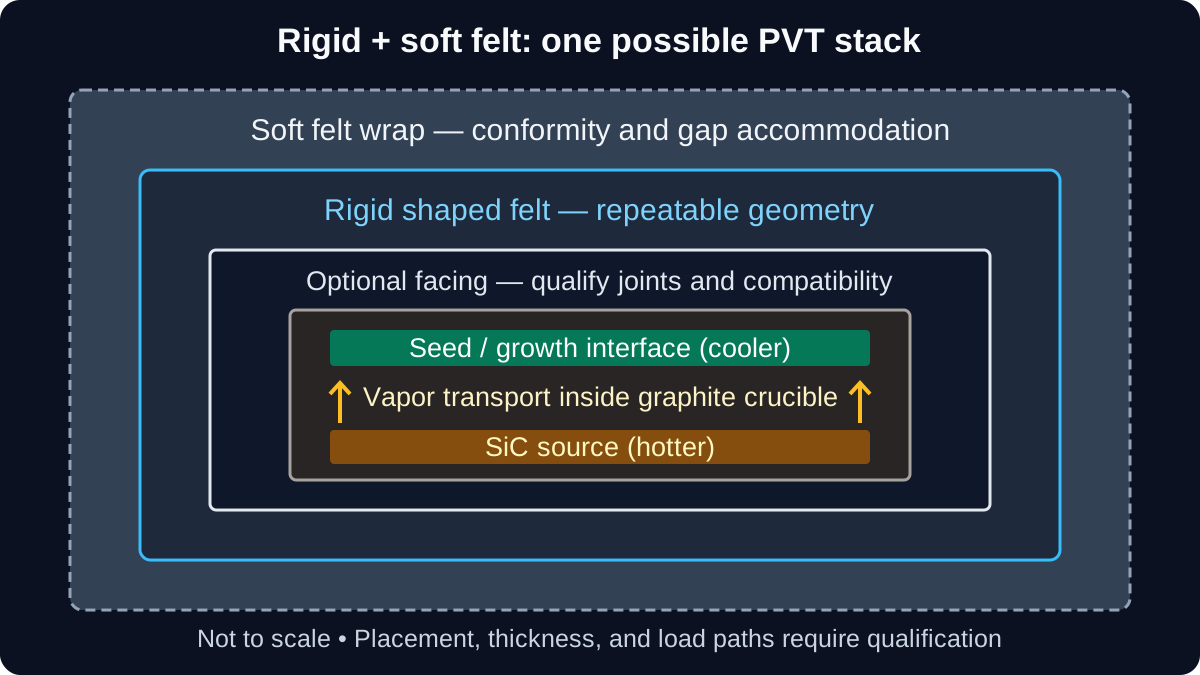
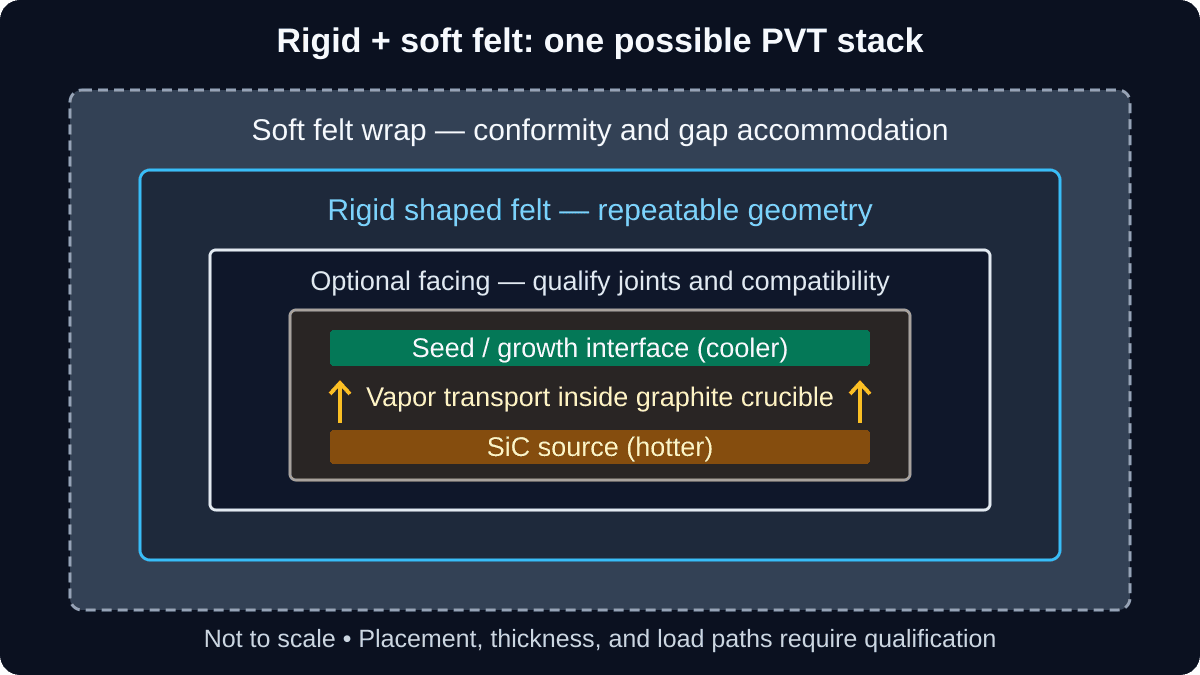
Conceptual cross-section, not to scale. The illustrated radial order is one possible arrangement. Chamber construction, RF coil placement, clearances, and load paths require a furnace-specific drawing. A surface facing does not guarantee silicon-vapor containment.
SGL Carbon describes flexible soft felts that can be cut to fit, and its furnace brochure describes self-supporting rigid components and optional surface protection. These establish available material formats, not performance guarantees for our products. Source 3: soft felt manufacturing, Source 4: furnace materials brochure, pp. 14–15.
For an assembly review, mark joints, removable sections, pyrometer openings, support interfaces, and likely vapor exposure paths. Specify soft felt by its installed thickness and compression, and rigid felt by its finished dimensions and orientation. Treat mechanical support capacity as a separate requirement from insulation performance.
4. Precursor Chemistry: Rayon-Based vs. PAN-Based Graphite Felt
Rayon (viscose) is regenerated cellulose; PAN is polyacrylonitrile. These names describe precursor families. Carbonization, subsequent heat treatment, purification, needling, binders, and surface treatments also affect the finished insulation. SGL's soft-felt manufacturing description illustrates the distinction between carbonized and more highly heat-treated graphite-like felt. Source 3.
What precursor chemistry can tell the buyer
PAN contains nitrogen in its starting polymer chemistry. That is a reason to ask how the finished grade is processed and qualified; it does not establish the residual nitrogen or release rate of the supplied felt. Conversely, a cellulose-derived precursor does not certify a nitrogen-free or metal-free finished component. Binder, machining, storage, and handling histories belong in the same review.
For HPSI programs, request an agreed residual-gas analysis (RGA) protocol and contamination qualification appropriate to the process. A precursor declaration cannot replace those records. For conductive growth, define the permitted contamination budget rather than assuming all PAN grades or all Rayon grades are interchangeable.
What precursor chemistry cannot establish
Do not assign a universal Rayon conductivity advantage, PAN price discount, fixed shrinkage rate, or lifetime in growth runs. Compare named grades under matched conditions and obtain comparable quotations. For rigid felt, include the carbonized binder and any adhesive or facing in the material declaration. Ash residue and element-specific analysis are different measurements: a total ash figure is not a GDMS elemental assay, and neither alone quantifies nitrogen outgassing.
5. Material Comparison and Procurement Evidence Matrix
The following matrix is a qualification framework, not a table of guaranteed material properties. Agree numerical acceptance limits with the furnace and process owners before sending the RFQ.
| Selection question | Rigid graphite felt | Soft graphite felt | Evidence to request |
|---|---|---|---|
| Shape retention | Candidate for self-supporting cylinders, boards, and machined sections | Needs an assembly arrangement that controls wrap position | Finished drawing, joint design, and assembly trial |
| Gap accommodation | Machined interfaces must allow the designed clearances | Can conform to curved surfaces and fill designed gaps | Installed thickness and compression record |
| Thermal conductivity | Depends on grade, orientation, binder, and exposure | Depends on grade, orientation, packing, and exposure | Temperature-dependent data at relevant gas and pressure |
| Density and uniformity | Check local variation after machining | Check thickness and mass under an agreed measurement load | Named method, sampling locations, and lot tolerances |
| Purity | Include binder, facing, and machining history | Include fiber processing and handling history | Lot-specific elemental results and separate ash method |
| Outgassing | Qualify the complete bonded or faced component | Qualify the supplied and conditioned blanket | Agreed bake profile, RGA method, and acceptance criteria |
| Dimensional change | Check cylinder fit, joints, and base flatness after conditioning | Check settling, shrinkage, and wrap continuity | Before/after dimensions under a defined exposure |
| Dust and handling | Inspect cut edges and any surface protection | Inspect cut edges, loose fibers, and handling damage | Handling instructions and agreed particulate inspection |
| RF response | Include electrical properties and conductive facings in the model | Include installed configuration and relevant electrical data | Heating-mode-specific model and assembly validation |
| Replacement cost | Include machining, installation time, and rejected components | Include cutting, wrapping, and reproducibility of assembly | Comparable quotes and cost per accepted production run |
If supplier thermal data stop below the proposed local operating temperature, request application qualification rather than silently extending the curve. SGL's rigid-felt brochure, for example, qualifies operation above its stated range by requiring an evaluation of process conditions. Source 4, p. 15.
Use this matrix in a drawing and material qualification inquiry with the grade names, local temperatures, and missing evidence identified.
6. Thermal Drift, Silicon Exposure, and 200mm Scaling
Diagnose drift before assigning a replacement interval
Conditioning, dimensional change, contamination, damaged joints, and altered surface condition are candidate causes of changed heat loss. Rising power demand is a useful investigation signal, but it does not by itself prove felt degradation: source evolution, pyrometer condition, heating-system changes, and crucible geometry can also change the observed response.
Where silicon-bearing vapor reaches carbon insulation, SiC formation is a possible chemical reaction pathway. Deposits or embrittlement can change the pore structure and thermal behavior. This is a mechanism to investigate, not evidence for a fixed conductivity increase, power penalty, or number of reusable runs. Visual appearance alone cannot identify the deposited phase. Use inspection and, where needed, material analysis to distinguish reaction products from handling damage or other deposits.
Review the leakage path as well as the felt. Our silicon vapor leakage and crucible sealing guide provides related RFQ context; it is not independent evidence for a felt lifetime. Foil or other surface treatments need joint, compatibility, and thermal-field qualification rather than being assumed to seal the entire assembly.
Why 200mm requires a new assembly qualification
For circular faces, increasing diameter from 150mm to 200mm increases area by (200/150)² ≈ 1.78. This is a geometric comparison, not a prediction of furnace power, insulation thickness, yield, or service life. Coil geometry, crucible dimensions, axial insulation, and radial heat paths must be evaluated together.
A published 8-inch PVT study modeled thermal-field changes and performed deposition experiments. It supports the need to examine seed-region temperature distribution and geometry, but its seedless/polycrystalline verification does not establish production single-crystal yield or a universal felt specification. Source 5: 8-inch thermal-field design.
A practical qualification sequence
- Freeze the baseline: record the approved drawing revision, felt grades and lots, installed thickness, conditioning, pressure, heating settings, and temperature measurement configuration.
- Screen the candidate: compare relevant thermal curves, purity and outgassing evidence, dimensional stability, and handling requirements. Record missing data explicitly.
- Change one defined variable: separate a precursor change from a thickness, facing, or joint redesign where practical. Document unavoidable combined changes.
- Compare fresh and conditioned states: use a defined exposure and repeat the same dimensions and thermal observations. Record measurement uncertainty and furnace configuration.
- Release against agreed criteria: process owners assess thermal repeatability and crystal results; procurement releases only the qualified grade, manufacturing route, and drawing revision.
Set investigation and retirement thresholds from the furnace baseline and process requirements. This article cannot supply a universal run count. Compare cost per accepted run = (material + machining + installation + conditioning + attributed scrap cost) / accepted runs using actual production records. A cheaper blanket can lose its price advantage if assembly variation increases rejected runs.
7. Engineering & Procurement Checklist: Qualifying Felt for 200mm RFQs
Attach the following to the supplier inquiry. An unchecked item identifies an evidence gap, not an automatic material rejection.
- Precursor and grade: identify Rayon, PAN, or a declared blend; name the manufacturer, grade, binder, facing, and change-control requirements.
- Purity: agree element-specific limits, test methods, detection limits, and lot traceability. Request ash results separately; do not treat GDMS as an outgassing test.
- Thermal and electrical data: specify temperature, atmosphere, absolute pressure, orientation, installed density, and uncertainty; identify extrapolations and RF-model assumptions.
- Dimensions and compression: provide rigid-part ID/OD, height, joints, tolerances, and load paths; define the load used to measure soft-felt thickness and its installed compression.
- Facings and exposed interfaces: mark vapor-exposed surfaces, foil or coating specifications, joint treatment, and inspection criteria. Qualify these as part of the assembly.
- Conditioning: agree the factory/customer bake sequence, ramp and dwell conditions, RGA acceptance criteria, and post-bake handling. Budget furnace time from that protocol.
- Packaging and release: agree clean handling, packaging, edge protection, incoming inspection, sample retention, and approval of manufacturing changes.
8. Frequently Asked Questions (FAQ)
Q1: Can soft carbon felt be reused after a failed growth run or seed loss?
Possibly, after the failure cause and the insulation condition are reviewed. Inspect tears, compression, deposits, and dimensional changes against the approved baseline. Quarantine suspect material after a leakage event and use the process owner's acceptance criteria; color or stiffness alone does not certify reuse or diagnose siliconization.
Q2: Why not build the entire insulation pack out of rigid graphite felt?
Rigid components provide shape retention but offer less conformity at assembly gaps. Soft layers can serve those locations, while an all-rigid design may also be viable when its joints and clearances are engineered appropriately. Compare the assembled thermal field and handling repeatability rather than choosing by format alone.
Q3: How can we reduce carbon fiber dust near the seed area?
Ask for edge finishing, compatible surface protection, packaging, and a supplier-approved cleaning method. Qualify any foil or coating with the thermal design. Inspect parts before loading and follow the furnace's documented cleaning procedure; a generic gas-blowing instruction is not a validated contamination-control process.
Q4: Is Rayon felt always cleaner than PAN felt for HPSI growth?
No universal ranking follows from precursor identity. Finished-grade purification, binder, conditioning, and handling matter. Require lot-specific elemental data and relevant gas-release measurements for either candidate. The sources cited here do not establish mandatory Rayon use or an equivalent nitrogen release rate for all PAN grades.
Q5: Does graphite felt affect RF induction heating?
Its electrical properties and arrangement can matter, especially when conductive facings or connected sections are added. The effect is grade-, geometry-, and frequency-dependent. Include relevant properties in the electromagnetic/thermal model and verify the assembled response; do not assume a universal small absorption fraction or shielding penalty.
Q6: What rigid-felt thickness is standard for a 200mm PVT furnace?
There is no universal thickness established by the sources cited here. Choose radial and axial insulation together from the available envelope, local temperature limits, thermal-field targets, heating arrangement, and maintenance access. A qualified 150mm stack is a starting point for modeling, not an automatic 200mm specification.
9. Next Steps and RFQ Specification Support
Start with the decision that is unresolved: shape retention, installation repeatability, contamination evidence, or drift after conditioning. Shortlist named grades against the matrix, then qualify the complete assembly. Neither a precursor label nor a low initial price demonstrates suitability for conductive or HPSI production.
Related Products & Hot-Zone Solutions
- PAN Carbon Felt Insulation — Product and RFQ context for PAN-derived insulation.
- Graphite Felt Insulation Options — Compare insulation formats and qualification needs.
- Rigid Carbon Felt Board — Review shaped insulation requirements.
- SiC PVT Crystal Growth Crucible Solutions — Coordinate crucible and hot-zone requirements.
Preparing an insulation RFQ? Send your drawing revision, dimensional envelope, local temperature and pressure range, heating mode, and purity/outgassing requirements through our contact inquiry portal. Include the current grade and observed drift if you are investigating a replacement. These inputs support a drawing review and quotation; final process qualification remains specific to your furnace.
References & Authoritative Sources
Sources reviewed October 31, 2026. Manufacturer documents describe their own materials; research papers describe their own test conditions. None is presented as a test certificate for our products.
- Ihle, J.; Wellmann, P. J. Determination of Thermal Properties of Carbon Materials above 2000°C for Application in High Temperature Crystal Growth. Crystal Research and Technology, 60(1), 2400080 (2025; first published online August 7, 2024). DOI: 10.1002/crat.202400080. Supports condition-specific characterization of rigid/soft felt and high-temperature model validation.
- Zhang, S.; Fan, G.; Li, T.; Zhao, L. Optimization of thermal field of 150 mm SiC crystal growth by PVT method. RSC Advances, 12, 19936–19945 (2022). Publisher article, DOI: 10.1039/D2RA02875A. Documents a particular rigid/soft insulation arrangement and thermal-field study.
- SGL Carbon. SIGRATHERM Soft Felt. Manufacturer's material and manufacturing description. Supports flexible format, cellulose-based manufacturing, and heat-treatment distinctions for the described products.
- SGL Carbon. The Performancers: Our specialty graphites for high-temperature furnaces, especially pp. 10–15. Manufacturer brochure (PDF). Describes soft/rigid formats, surface options, and application-specific limits.
- Zhang, S. et al. Design and Optimization of Thermal Field for PVT Method 8-Inch SiC Crystal Growth. Materials, 16(2), 767 (2023). Publisher article, DOI: 10.3390/ma16020767. Supports geometry-specific 200mm thermal-field analysis; its deposition validation is not a commercial single-crystal yield guarantee.
Author

Categories
More Posts
Porous Graphite Deflector and Filter Plates in SiC PVT: Porosity, TaC Passivation, and Stoichiometric Flow Control
Select porous graphite deflector and filter plates for SiC PVT: compare porosity, verify TaC coverage, and prepare permeability and purity data for an RFQ.
Managing Silicon Vapor Leakage in SiC PVT: Sealing Strategies for Graphite Crucibles
Use this RFQ guide to manage silicon vapor leakage in SiC PVT graphite crucibles with density, thread tolerance, labyrinth seal, and TaC coating checks.
Isostatic Graphite Grain Size for SiC Crucibles: Balancing Machinability, Strength, and Yield
Evaluate isostatic graphite grain size for SiC PVT crucibles, from CNC thread integrity to TaC coating fit, thermal shock trade-offs, and RFQ checks.