
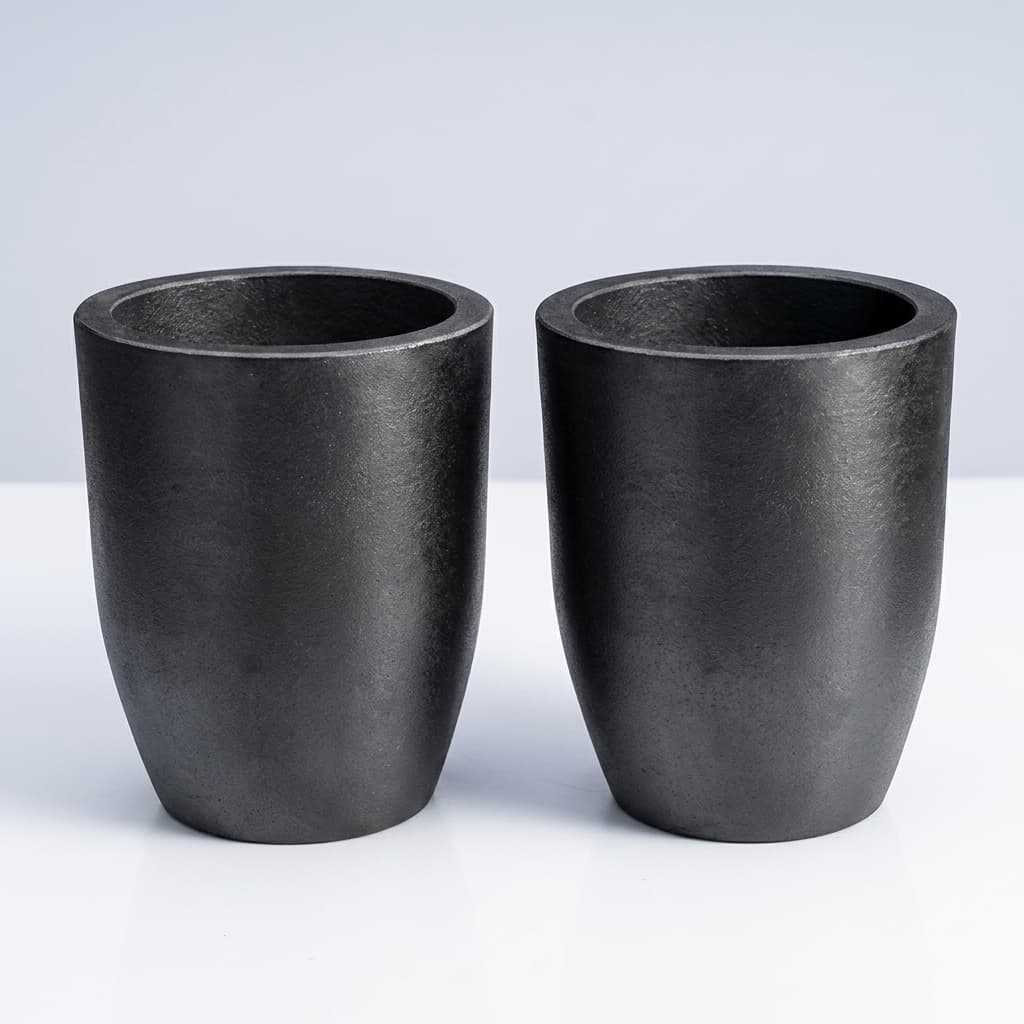
8-Inch SiC Crucible Procurement: Managing Thermal Gradients and Structural Integrity
Procurement guide for 8-inch SiC crucibles: thermal-gradient risks, graphite purity specs, GDMS checks, supplier questions, and 200mm PVT DFM limits.
The global power electronics industry is undergoing a shift from 150mm (6-inch) to 200mm (8-inch) Silicon Carbide (SiC) wafer production. Driven by demand from electric vehicles, power modules, photovoltaics, and industrial drives, 8-inch wafers provide roughly 1.8x the wafer area of 6-inch substrates, creating a path to lower device cost once crystal yield and slicing yield are stable. However, for procurement teams, equipment engineers, and crystal growth specialists, this transition introduces a new set of challenges in the Physical Vapor Transport (PVT) process.
Growing an 8-inch SiC crystal is not simply a matter of scaling up the dimensions of your existing 6-inch graphite hot zone. The physics of sublimation at 2,300°C dictate that as the diameter of the crucible increases, maintaining the critical thermal gradients and structural stability becomes materially more difficult. A graphite crucible that performs well at 6 inches may suffer from thermal stress, vapor leakage, or localized hot spots when scaled to 8 inches.
This procurement guide analyzes the engineering challenges of 8-inch SiC crystal growth and provides a practical blueprint for specifying high-purity isostatic graphite crucibles that support repeatable yield targets at the 200mm scale.
Scope and limits, July 18, 2026: This guide applies to custom 200mm SiC PVT graphite crucible sets, lids, liners, and related hot-zone components for global procurement teams. It is not a universal furnace recipe: final dimensions, wall thickness, insulation geometry, coil frequency, and cooling profiles still need validation against your own growth furnace, thermometry, FEM model, and post-growth crystal data. For product geometry context, compare the SiC PVT crucible and SiC PVT crystal growth solution pages before issuing an RFQ.
The Physics of Scaling: Why 8-Inch is Not Just "Bigger"
At the heart of the SiC PVT process is the thermal gradient. To drive the sublimation of SiC powder at the bottom of the crucible and the subsequent condensation on the seed crystal at the top, a precise axial (vertical) temperature gradient of approximately 20°C to 30°C per centimeter is required. Concurrently, a delicate radial (horizontal) gradient must be maintained to ensure a slightly convex growth front, which helps suppress defect propagation, particularly basal plane dislocations and micropipes.
When expanding the crucible diameter to accommodate an 8-inch boule, three critical physical dynamics shift drastically:
- Radial Temperature Gradients (ΔTr): As the surface area of the growth interface increases, heat loss from the center to the edge becomes more pronounced. In an 8-inch crucible, the center of the SiC powder bed can be significantly cooler or hotter than the periphery, depending on the heating coil design. This non-uniformity disrupts the C/Si ratio across the vapor phase, leading to uneven nitrogen doping (which causes resistivity variations) and the dreaded inclusion of unwanted polytypes (such as 15R or 6H instead of the desired 4H-SiC).
- Thermal Mass and Heat Transfer: An 8-inch crucible requires substantially thicker walls to maintain structural integrity under high temperatures. However, thicker walls increase the thermal resistance from the external induction coils (or resistance heaters) to the internal cavity. This means the external temperature must be driven higher to achieve the necessary internal sublimation temperature, placing immense strain on the outer graphite susceptor and the insulation felt.
- Mechanical Stress During Cool-Down: At 2,400°C, the coefficient of thermal expansion (CTE) mismatch between the solidifying SiC boule and the graphite lid becomes a massive risk factor. The sheer mass of an 8-inch boule exerts tremendous force. If the graphite is too rigid or the lid geometry is poorly designed, the cooling phase will result in crucible fracture or, worse, crystal cracking.
Visualizing the 8-Inch Thermal Challenge
Figure: The shift in radial thermal dynamics when scaling from 150mm to 200mm SiC growth.
Material Specifications: The 8-Inch Baseline
To mitigate these physical challenges, the material properties of the isostatic graphite used for 8-inch crucibles must be strictly regulated. Off-the-shelf industrial graphite is entirely unsuitable. The material must function not just as a container, but as a high-purity thermal conductor and chemical barrier.
1. Ultra-High Bulk Density (greater than 1.85 g/cm³)
For an 8-inch crucible body, high bulk density is non-negotiable. Lower density implies higher open porosity, which is catastrophic at the 200mm scale. Porous walls allow silicon and carbon vapor to permeate the graphite, leading to two severe issues:
- Vapor Loss: Loss of the Si/C vapor diminishes the supersaturation required for crystal growth, reducing the final boule length and lowering your yield.
- Graphitization and Embrittlement: Vapor reacting within the graphite pores causes the crucible to harden and embrittle. In an 8-inch system, this hardening drastically limits the crucible's ability to flex during cool-down, guaranteeing cracking.
2. Impurity Limits and the GDMS Standard
The larger the crucible, the higher the total mass of graphite interacting with the growth environment. Therefore, the parts-per-million (ppm) limit for impurities must be rigidly enforced. Elements like Boron (B), Iron (Fe), Aluminum (Al), and Titanium (Ti) act as deep-level dopants or defect nucleation sites, destroying the semi-insulating or specific N-type properties of the wafer.
Historically, ash content (less than 5 ppm) measured via ICP-MS was the standard. However, as 8-inch production matures, the industry is shifting toward Glow Discharge Mass Spectrometry (GDMS). For example, the T/CASAS 048-2025 standard explicitly specifies GDMS testing for isostatic graphite used in SiC single crystal growth. Procurement teams should now require GDMS certification for all 8-inch hot zone batches to ensure trace metals are in the parts-per-billion (ppb) range after halogen purification.
3. Machining Tolerances and Vapor Containment
A 200mm crucible lid has a massive circumference. If the threading connecting the lid to the crucible body is machined with excessive clearance, vapor will leak along the thread path. Conversely, if the clearance is too tight, the threads will seize at 2,300°C, making extraction of the boule impossible without destroying the assembly. The CNC machining tolerance stack-up, often specified around tight hundredths-of-a-millimeter features for precision interfaces, must account for the specific CTE of the graphite grade chosen.
Technical Comparison: 6-Inch vs. 8-Inch Crucible Requirements
When reviewing supplier quotes or engineering drawings, use this baseline comparison to ensure the graphite specs meet 200mm process demands.
| Parameter | 150mm (6-Inch) Standard | 200mm (8-Inch) Requirement | Procurement / Engineering Rationale for 8-Inch |
|---|---|---|---|
| Bulk Density | greater than 1.82 g/cm³ | greater than 1.85 g/cm³ | Higher density prevents vapor permeation across a massively expanded inner surface area, preventing crucible embrittlement. |
| Average Grain Size | less than 10 µm | less than 5 µm (Ultrafine) | Ultrafine grain structure ensures isotropic thermal conductivity and prevents micro-chipping during the machining of large-diameter ACME threads. |
| Impurity Verification | ICP-MS (Ash less than 5 ppm) | GDMS (Trace Metals ppb) | The massive total volume of an 8-inch crucible means even single-digit ppm impurities can outgas enough volume to contaminate the larger boule. |
| Lid Geometry | Standard Flat / Slight Cone | Deep Conical / Custom Profiling | A deeper conical lid is required to force the thermal gradient toward the center, compensating for the severe radial heat loss at the 200mm edge. |
| Porous Inner Plates | Optional | Highly Recommended | Engineered porous graphite plates are increasingly used inside 8-inch crucibles to act as a vapor distribution hub, balancing the C/Si ratio across the wide growth front. |
| Wall Thickness | Standard | +20% to +35% Thicker | Required to withstand the massive mechanical stress of a 200mm boule cooling and contracting against the crucible walls. |
Treat the numeric values above as RFQ screening gates, not universal design constants. A qualified supplier should be able to explain how each value changes when your process shifts from induction to resistance heating, from nitrogen-doped conductive growth to semi-insulating growth, or from one hot-zone insulation stack to another.
The 8-Inch SiC Crucible Procurement Checklist
Before issuing a Purchase Order (PO) for an 8-inch hot zone assembly, ensure your supplier can meet these specific gating criteria:
- Provide GDMS Purity Reports: Does the supplier provide batch-specific Glow Discharge Mass Spectrometry reports rather than generic "Ash less than 5 ppm" certificates?
- Halogen Purification Capacity: Do they perform high-temperature halogen purification in-house? Standard vacuum baking is insufficient for the purity levels required at 200mm.
- DFM Review for Threading: Have they conducted a Design for Manufacturing (DFM) review on your lid-to-body thread clearance? They must prove their CNC limits account for the thermal expansion of a 250mm+ outer diameter.
- Isotropic Verification: Can they provide data proving the isostatic graphite has a CTE ratio (with/against grain) approaching 1.0? Anisotropic graphite will warp the thermal field.
- Packaging Protocol: Are the 8-inch crucibles vacuum-sealed immediately after purification? Due to their massive volume, 8-inch parts can absorb significant atmospheric moisture during transit.
If your team is moving from drawing review to supplier qualification, send the process window, target OD/ID, lid interface, purity-report expectation, and coating preference through the contact page. That keeps the RFQ focused on engineering variables instead of generic catalog dimensions.
Frequently Asked Questions (FAQ)
Q: Can we use the same induction heating coil frequency for 8-inch crucibles as we did for 6-inch?
A: Generally, no. Because the 8-inch crucible has a larger diameter and thicker walls, the skin depth of the induction heating must change. Engineers often lower the RF frequency to achieve deeper penetration into the graphite susceptor and crucible wall, ensuring the heat reaches the inner cavity uniformly. Alternatively, many 8-inch systems are moving entirely to resistance-heating furnaces for better thermal control.
Q: Why are our 8-inch crucibles cracking during the cool-down phase, while our 6-inch ones survived?
A: This is almost always a CTE mismatch issue combined with thermal mass. An 8-inch SiC boule exerts a massive outward force as it cools at a different rate than the graphite. If your crucible wall is too thin, or if the graphite has embrittled due to low density (vapor absorption), it will shatter. You must optimize wall thickness and ensure bulk density is greater than 1.85 g/cm³.
Q: Are TaC (Tantalum Carbide) coatings necessary for 8-inch crucibles?
A: While not strictly mandatory, TaC coatings are highly advantageous in 8-inch systems. The coating seals the porosity of the graphite entirely, reflecting heat inward (improving thermal uniformity) and preventing any impurity outgassing from the graphite substrate into the larger vapor cavity.
Sources and Further Reading
To support your procurement and engineering decisions, review these standards, research papers, and material references before locking the 8-inch RFQ:
- 200mm PVT thermal-field research: Effects of the thermal field on the diameter enlargement of 200 mm SiC by PVT method - documents how radial and axial temperature-gradient control affects marginal polycrystals and polytype inclusions.
- 8-inch thermal-field simulation: Design and Optimization of Thermal Field for PVT Method 8-Inch SiC Crystal Growth - models how heater position and hot-zone structure affect large-diameter PVT temperature distribution.
- SiC raw-material purity and GDMS: Study on Purification Technology of Silicon Carbide Crystal Growth Powder - uses XRD and GDMS to evaluate purification of SiC crystal-growth powder.
- Specialty graphite operating context: SGL Carbon: Specialty graphites for semiconductor crystal growth - describes graphite requirements for SiC PVT crystal growth at temperatures above 2400°C.
- Isostatic graphite standards announcement: Official Release of Two Isostatic Graphite Standards for SiC Single Crystal Growth - summarizes T/CASAS 036-2025 and T/CASAS 048-2025 for purity determination and isostatic graphite used in SiC single-crystal growth.
Scale to 8-Inch with Confidence
Transitioning to 200mm SiC production requires flawless thermal and mechanical engineering. Send us your hot zone CAD drawings, and our engineering team will provide a comprehensive DFM review, material recommendation, and GDMS-certified quotation for your 8-inch crucibles.
Author

Categories
More Posts
Preventing Graphite Crucible Thread Seizure and Vapor Leakage in SiC PVT Growth
An engineering guide to graphite crucible thread tolerances, CTE mismatch, and TaC coatings for preventing vapor leakage and seizure in SiC PVT growth.
Graphite Crucible Degradation Mechanisms in SiC PVT Growth: Silicon Vapor Corrosion and Lifespan
Guide to graphite crucible degradation in SiC PVT growth: silicon vapor corrosion, graphitization, yield risk, retirement triggers, and RFQ lifespan checks.
Trace Metal Contamination in SiC PVT Growth: GDMS Benchmarks and Halogen Purification
How halogen purification removes Boron, Vanadium, and Iron from graphite crucibles. A procurement guide to GDMS purity specifications for semi-insulating SiC.