
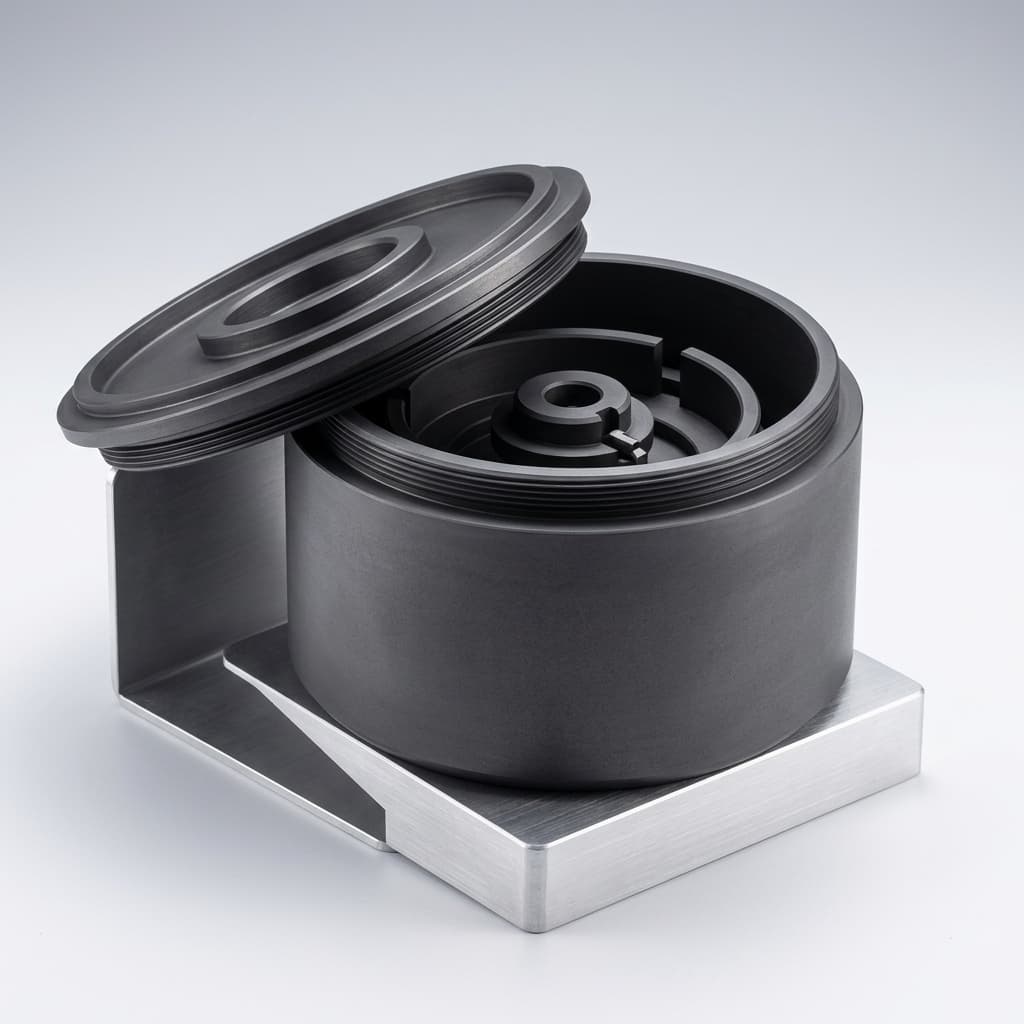
Graphite Hot Zone Design for SiC Growth: A Buyer's Blueprint
A breakdown of the critical graphite components in a SiC PVT furnace, focusing on the crucible, susceptor, heater, and insulation felt, and how to source them.
Growing 6-inch and 8-inch Silicon Carbide (SiC) crystals is fundamentally an exercise in precise thermal management. At 2,200°C, the sublimation and deposition rates are entirely controlled by the axial and radial thermal gradients inside the furnace.
These gradients are established by the Graphite Hot Zone. As an OEM buyer or equipment engineer, sourcing these components isn't just about buying machined graphite; it's about procuring a stable thermal architecture. In this breakdown, we examine the core components of the SiC hot zone, the specific graphite grades required for each, and how to source them to achieve repeatable yield.
Executive Summary
- Material Matching: Isostatic graphite is commonly reviewed for crucibles and contamination-sensitive thermal-field parts because its more uniform properties can support repeatable thermal behavior.
- Insulation Integrity: PAN-based rigid carbon felt is required to trap heat and establish the precise vertical thermal gradient (e.g., 20-30°C/cm) needed for SiC sublimation.
- Machining Precision: Thread clearances and mating fits should be defined by drawing to reduce Si-vapor leakage risk while allowing for thermal expansion at high temperature.
The Core Components of the Hot Zone
A typical PVT hot zone consists of several concentric layers of graphite and carbon materials, each serving a distinct thermodynamic purpose.
| Component | Material | Primary Function | Sourcing Watch-Outs |
|---|---|---|---|
| Crucible & Lid | High-purity isostatic graphite, ash target by RFQ | Contains the SiC source powder and seed crystal. | Thread precision is critical. Loose threads increase vapor leakage risk. |
| Susceptor | Extruded or Isostatic Graphite | Absorbs RF induction energy and transfers heat to the crucible. | Must have uniform electrical resistivity to prevent localized hot spots. |
| Heater | High-Density Graphite | Acts as the primary resistance heating element (in resistance furnaces). | Machining tolerances directly impact the uniform resistance profile. |
| Insulation Ring/Shield | Rigid Carbon Felt (PAN/Rayon) | Maintains the thermal gradient and prevents heat loss. | Must be outgassed properly to avoid releasing trapped oxygen/moisture. |
Why CNC Machining Tolerances Matter
Graphite is notoriously brittle and abrasive, making it difficult to machine to tight tolerances without causing edge chipping or tool wear. However, in a SiC hot zone, tolerances dictate thermal symmetry.
If a crucible lid is machined with excessive clearance, sublimation gas can escape, reducing process stability and potentially damaging the surrounding susceptor. Similarly, if the threads connecting the seed holder to the lid are not sufficiently concentric, the seed can sit at an angle and change the local growth conditions.
Visualizing the Hot Zone Architecture
Figure: The concentric arrangement of a PVT induction furnace.
Procurement Strategy for Buyers
When engaging an OEM manufacturer for your hot zone components, consider the following workflow:
- Material Selection by Component: Do not over-specify. Keep the highest purity targets for components nearest the growth environment, then review whether outer susceptors, heaters, and supports can use different graphite grades without increasing contamination or thermal-field risk.
- DFM (Design for Manufacturing) Review: Submit your 2D CAD files to the supplier and ask for a DFM review. A capable graphite machining factory will suggest thread modifications or corner radii adjustments to prevent chipping during assembly.
- Packaging Requirements: Graphite is porous and absorbs moisture. Ensure your supplier vacuum-seals all purified parts immediately after cooling and uses foam-lined wooden crates for export.
By aligning material grades with their specific thermal functions, procurement teams can optimize the BOM cost of the SiC hot zone without sacrificing crystal yield.
Essential Machining Tolerances to Specify
When sending your CAD files, explicitly state these tolerances to ensure the hot zone performs identically across multiple furnace runs:
- Thread Clearance: Define ACME or square-thread clearance by furnace temperature, graphite grade, and assembly practice. Too tight can increase seizure risk; too loose can increase vapor leakage risk.
- Seed Holder Concentricity: Define the concentricity requirement with the process owner. Seed tilt can disturb the local thermal gradient and increase polytype or morphology risk.
- Surface Roughness (Inner Wall):
Ra 1.6 - 3.2. A uniform surface finish ensures predictable thermal radiation emissivity inside the cavity.
Related Solutions & Products
- Graphite Hot Zone Components - Discover our full-assembly capabilities for PVT furnaces.
- PAN Carbon Felt Insulation - High-purity rigid carbon felt shields for thermal gradient control.
Frequently Asked Questions
Q: Should I use extruded or isostatic graphite for the susceptor?
A: Isostatic graphite has an isotropic grain structure, meaning its thermal and electrical properties are identical in all directions. This prevents uneven induction heating. Extruded graphite is anisotropic and can cause skewed thermal gradients. Always use isostatic graphite for SiC susceptors.
Q: How often does the carbon insulation felt need to be replaced?
A: Rigid PAN-based carbon felt usually lasts much longer than the crucible. However, it gradually absorbs Si vapor and hardens over many runs, losing its insulating properties. Most operators replace the inner shield every 10-15 runs, while outer layers can last for months.
Q: Can your factory machine the threading to match our existing seed holders?
A: Yes. Threading, including coarse ACME or square threads used in high-temperature graphite, can be reviewed from your drawing. Send a 2D thread profile and mating-part notes so fit, clearance, and inspection method can be aligned before quoting.
Optimize Your PVT Hot Zone
Send CAD drawings, operating assumptions, and acceptance criteria so we can review machining feasibility, DFM risks, and quotation basis for your SiC hot-zone parts.
Author

Categories
More Posts
Preventing Graphite Crucible Thread Seizure and Vapor Leakage in SiC PVT Growth
An engineering guide to graphite crucible thread tolerances, CTE mismatch, and TaC coatings for preventing vapor leakage and seizure in SiC PVT growth.
Graphite Crucible Degradation Mechanisms in SiC PVT Growth: Silicon Vapor Corrosion and Lifespan
Guide to graphite crucible degradation in SiC PVT growth: silicon vapor corrosion, graphitization, yield risk, retirement triggers, and RFQ lifespan checks.
Trace Metal Contamination in SiC PVT Growth: GDMS Benchmarks and Halogen Purification
How halogen purification removes Boron, Vanadium, and Iron from graphite crucibles. A procurement guide to GDMS purity specifications for semi-insulating SiC.